

Skip to content

Add a protocol, not another product.

AI Suite deploys, monitors and evaluates radiological AI modules in one standardized framework, with computer-aided triage and notification for qualified healthcare professionals.

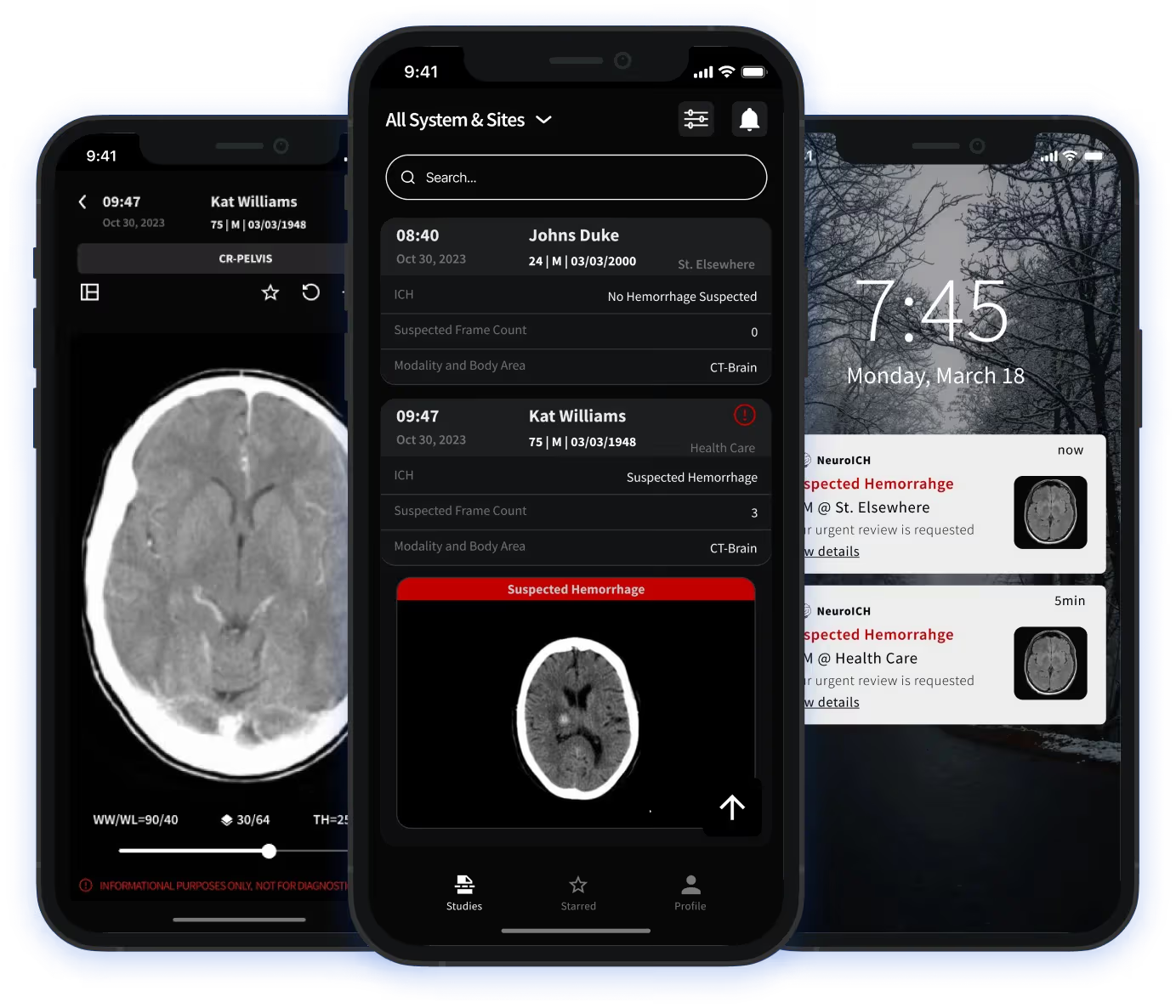
NeuroICH on mobile: a suspected hemorrhage notification and the study list with a non-contrast head CT preview
NeuroICH

FDA 510(k) K241719November 7, 2024

NeuroICH™ flags suspected brain bleeds.

Triage and notification for suspected intracranial hemorrhage on non-contrast head CT in the acute setting. Class II, product code QAS, 21 CFR 892.2080. It works in parallel to the standard read: notification only, never a diagnosis, and no case leaves the reading queue. Preview images in a notification are non-diagnostic.

Free for low and middle-income countries

What K241719 means
Sensitivity (95% CI 89.68–97.43)
94.81%
Sensitivity (95% CI 89.68–97.43)
Specificity (95% CI 88.50–95.21)
92.53%
Specificity (95% CI 88.50–95.21)
Mean notification time, 128 eligible scans
0.37 min
Mean notification time, 128 eligible scans

510(k) study, 376 non-contrast head CT studies. Study results, not a guarantee of clinical outcome.

Modules

Each module, its own number.

Each clearance covers only its own module. AI Suite as a whole is not a cleared device.

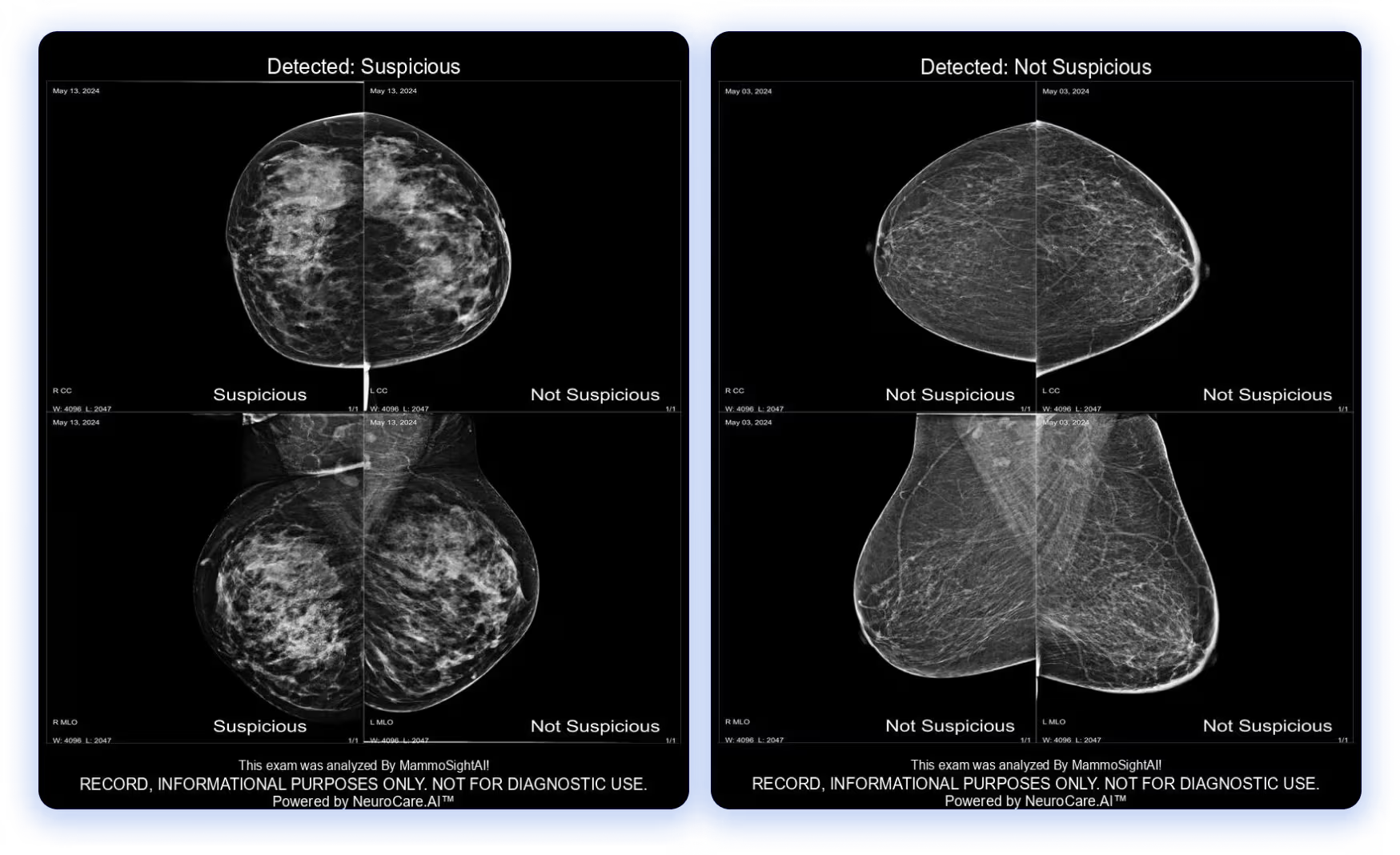
MammoSightAI output on two screening mammograms, one tagged suspicious and one not suspicious
Sensitivity (CI 86.0–92.9)
89.8%
Sensitivity (CI 86.0–92.9)
Specificity (CI 93.1–96.5)
95.0%
Specificity (CI 93.1–96.5)
AUC (CI 0.948–0.977)
0.963
AUC (CI 0.948–0.977)

FDA 510(k) K252954May 4, 2026

MammoSightAI™ sorts the screening worklist.

Prioritizes compatible FFDM and DBT screening mammograms by tagging suspicious findings. Class II, product code QFM. Passive notification only; the radiologist reviews every exam.

510(k) study, 1,019 cases (468 FFDM, 551 DBT). Lossy-compressed mammographic images and digitized film-screen images are for reference only, not for primary diagnostic interpretation.
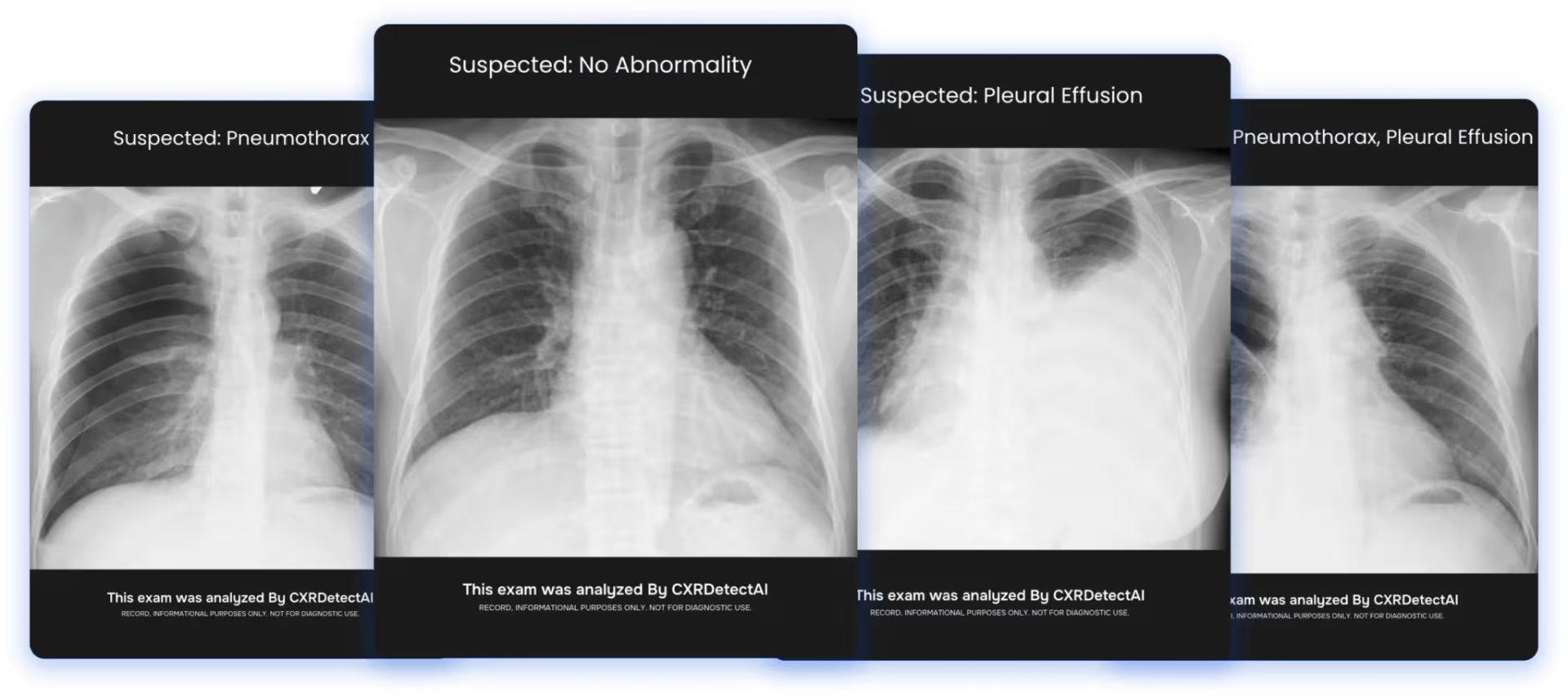
CXRDetectAI study-level results on four frontal chest X-rays: pneumothorax, no abnormality, pleural effusion, and both

FDA 510(k) K253751July 8, 2026

CXRDetectAI™ moves chest X-rays up the list.

Triage of frontal AP and PA chest radiographs in adults 22 and older, for suspected pleural effusion and pneumothorax only. It prioritizes the study; it does not localize findings, reorder the queue or rule out disease.

510(k) study, 839 radiographs

Pleural effusion

96.4%
Sensitivity
93.8%
Specificity

Pneumothorax

97.4%
Sensitivity
96.8%
Specificity

Investigational: not cleared, not for sale

NeuroLVO™

Large vessel occlusion detection on CT and CTA of the head, for stroke care.

DenseViewAI™

Breast density assessment on mammography.

These modules are not cleared by the FDA and are not available for sale.

How it runs

Five layers, every module.

AI Suite runs inside RadioView.AI as AI Findings and AI Analysis, or standalone next to your PACS through ConnectAI. Same framework either way.

The Spine: one screen, reconfigured per specialty. Switch from acute stroke to STEMI to personal injury and the shell stays put, while the imaging module, the extraction preset and the registry change.

Third-party detection modules run alongside ours, with the same monitoring and audit logging, so AI Suite can be one orchestration layer across vendors.

Computer-aided triage and notification support for qualified healthcare professionals. Outputs support, never replace, their judgment.

  1. L5Audit systemPerformance monitoring and audit logging for every module.
  2. L4Output interfaceStandardized outputs for each module, shown in the reading workflow.
  3. L3Module frameworkOne standardized module API for our own and third-party modules.
  4. L2Processing engineScalable compute for analysis.
  5. L1Integration layerDICOM-compliant PACS and RIS integration through ConnectAI™.

Cleared triage, in your worklist.

Deploy the cleared modules inside RadioView.AI or next to the PACS you run, each under its own clearance.

HITRUST CSF Certified and HIPAA Compliant

Role-based access, audit logging on every module, encryption and a business associate agreement. The Trust Center sets out the details.

Trust Center
NextAI-RCM