From Scan to Report with RadioView.AI
RadioView.AI is designed to reduce report turnaround time by up to 38.8%. Here is the technology behind the speed, from DICOM ingestion to the signed report.
 Junaid Kalia, MDFounder and CEO, SaveLife.AI, March 15, 2026
Radiology at a breaking point
The global shortage of radiologists is not a future problem; it is today's emergency. Imaging volumes are rising, radiologist supply is stagnating, and the pressure to interpret studies faster without sacrificing accuracy is intensifying across every health system.
The traditional radiology workflow (a radiologist reviewing images, dictating findings, waiting for transcription, then reviewing and signing the final report) was designed for lower imaging volumes and more generous time. That world no longer exists.
RadioView.AI™ was built to answer one question: what does radiology look like when AI handles the reporting bottleneck?
What the platform is designed to do
RadioView.AI is designed to reduce report turnaround time by up to 38.8%, with uninterrupted workflows. The time comes back from the steps around the read, not from the read itself: setting up the study, pulling priors, dictating boilerplate, re-typing measurements and waiting on transcription.
RadReport: how automated reporting works
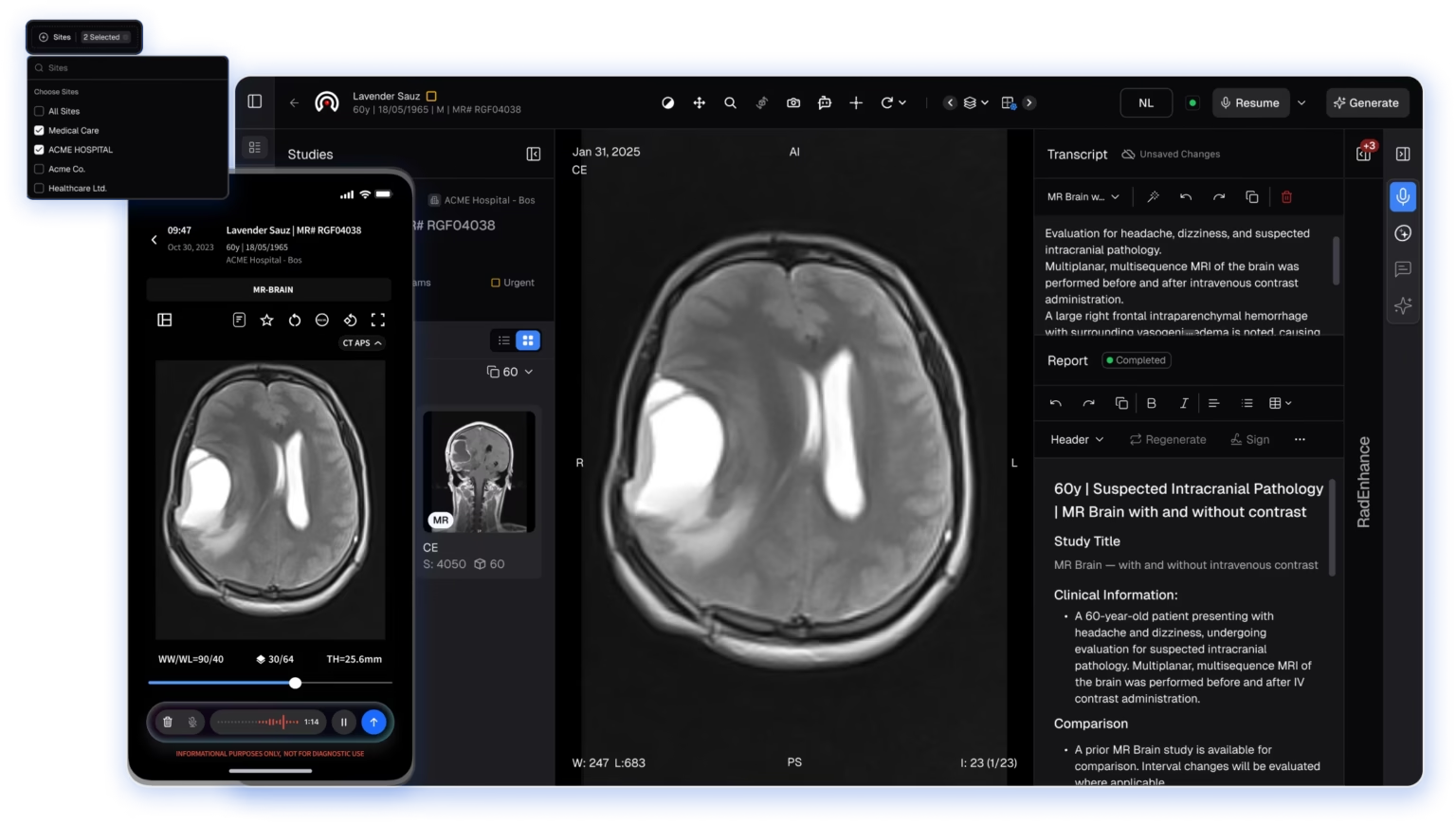
RadReport™ is RadioView.AI's reporting experience, built on Automated Radiology Report Generation (ARRG): voice-enabled, structured reporting. It is not a simple template filler. It drafts a structured report by:
- Receiving the imaging study through DICOM integration with the site's existing PACS
- Letting the radiologist record their intent, spoken findings that RadReport transcribes in real time
- Applying AI to structure, refine and draft a complete report
- Delivering the draft for the radiologist's review, edits and sign-off
RadMatcher loads the matching report template when a study is opened, so dictation can start straight away.
AI-Viewer: the all-in-one DICOM platform
Speed in reporting means nothing if the viewing experience creates friction. RadioView.AI's AI-Viewer is a DICOM-compliant image viewer on web and mobile, built to support:
- AI measurements: automated segmentation and volumetric calculations, with measurements pre-filled instead of recorded by hand
- AI hanging protocols: automatic arrangement of images by modality, body part, clinical context and radiologist preference
- AI Extract: turns reports into structured data, pulling out key findings, measurements, diagnoses and follow-up recommendations
- AI Chat: collaborative chat with dynamic patient summaries
Multi-site, zero-footprint access with role-based authentication lets teleradiology teams read from any location, with PACS connections managed through the ConnectAI™ integration gateway.
RadEnhance: the details a report should not miss
RadEnhance surfaces real-time suggestions to the radiologist while a draft report and its dictation are being generated: clinical and documentation details that are easy to miss before sign-off. The radiologist reviews every suggestion and decides what goes into the report.
NeuroICH: FDA-cleared triage in the worklist
RadioView.AI is also the host platform for SaveLife.AI's AI Suite modules. One of them is NeuroICH™, cleared under FDA 510(k) K241719 as computer-aided triage and notification software for suspected intracranial hemorrhage on non-contrast head CT.
NeuroICH runs a notification-only, parallel workflow. In its 510(k) study of 376 non-contrast head CT studies it reported a sensitivity of 94.81% (95% CI 89.68–97.43), a specificity of 92.53% (95% CI 88.50–95.21) and a mean notification time of 0.37 ± 0.20 minutes. Its flags support the radiologist's read; they do not replace it, and they never remove a case from the normal reading queue.
Compliance that healthcare demands
RadioView.AI is HIPAA Compliant, with data encrypted at rest and in transit, and deploys in the cloud, on premise or as a hybrid, to meet the security requirements of hospital systems and teleradiology groups alike. The RadioView.AI platform itself is FDA 510(k) cleared under K260936 as a medical image management and processing system; that clearance covers the imaging platform, not the AI modules, each of which carries its own K-number.
The future of radiology
The radiologist of 2026 should not spend their expertise on typing reports. They should spend it on clinical judgment, complex case review, multidisciplinary consultation and the interpretive work that AI cannot replicate. RadioView.AI is built to take the rest off their desk, across every layer of the workflow, from DICOM ingestion to structured report delivery.
AI outputs support, not replace, the interpreting radiologist's judgment.
Ready to see RadioView.AI in action? Book a demo.
Junaid Kalia, MDFounder and CEO, SaveLife.AIAll articles