The Radiologist Shortage Crisis: What It Means for Patient Care in 2026
The US faces a projected radiologist deficit of more than 30% by 2030. Here is what is driving the shortage, what it means for patients, and how AI tools like RadioView.AI give radiology practices a path forward.
 Junaid Kalia, MDFounder and CEO, SaveLife.AI, April 28, 2026
The United States is approaching a radiology staffing crisis that can no longer be described as a future problem. The American College of Radiology projects a deficit exceeding 30% of the radiologist workforce by 2030. Imaging volumes are climbing. The pipeline of trained replacements is not keeping pace. And the patients who depend on timely, accurate reads are already feeling the consequences.
This article examines the root causes of the shortage, its measurable impact on patient care, and the AI-driven approaches that leading practices are deploying today to close the capacity gap.
Why the Shortage Is Getting Worse
The radiologist shortage is not the product of a single cause. It is the convergence of several structural trends that have been building for over a decade.
Training pipeline constraints
Radiology residency slots are allocated through a system that has not kept pace with the explosive growth in imaging demand. Training a radiologist requires four years of residency after medical school, often followed by one or more years of subspecialty fellowship. Even if training capacity expanded today, the workforce impact would not be felt for five to seven years.
Accelerating retirements
A significant portion of the current radiologist workforce is approaching retirement age. The replacement rate, new radiologists entering practice, falls short of the exit rate. The result is a net loss of experienced capacity that compounds annually.
Rising imaging volumes
The US population is aging, and older patients require more diagnostic imaging. The growth in CT, MRI, PET, and ultrasound use consistently outpaces workforce projections. More studies, ordered at higher complexity, with the same number of readers.
Burnout and documentation burden
Radiologists increasingly cite administrative and documentation overhead as a primary driver of early retirement and reduced hours. Generating detailed structured reports for each study, often while simultaneously managing worklists, handling calls, and supervising residents, creates a cognitive and time burden that degrades both throughput and satisfaction.
What the Shortage Means for Patients
Workforce shortages in radiology translate directly into patient outcomes.
- Longer wait times for results. When worklists exceed radiologist capacity, turnaround times stretch, from hours to days in some settings. For time-sensitive findings such as stroke, pulmonary embolism, or acute hemorrhage, delays are clinically consequential.
- Increased error rates under pressure. Radiologist fatigue and high-volume reading conditions are associated with higher rates of missed or mischaracterized findings. A burned-out radiologist working through a backlog of 80+ studies is not operating at peak diagnostic performance.
- Reduced access in underserved markets. Rural and community hospitals are disproportionately affected. These facilities cannot compete with academic or metropolitan centers on compensation, and as a result, some have lost radiology coverage entirely, relying on teleradiology as the only option.
- Delayed cancer detection. Screening programs depend on timely reads. Backlogs in mammography, lung cancer screening CT, and colorectal imaging programs mean earlier-stage cancers are identified later, when treatment options are more limited.
Solutions Being Deployed in 2026
Radiology practices and health systems are not waiting for the training pipeline to catch up. Several approaches are gaining adoption at scale.
AI Pre-Read and Triage
The most impactful near-term intervention is AI that triages the worklist: it flags studies with suspected urgent findings so they are read sooner, while every study is still read by a radiologist. Cleared triage tools such as NeuroICH (FDA 510(k) K241719) work this way, notifying the care team in parallel with the normal read.
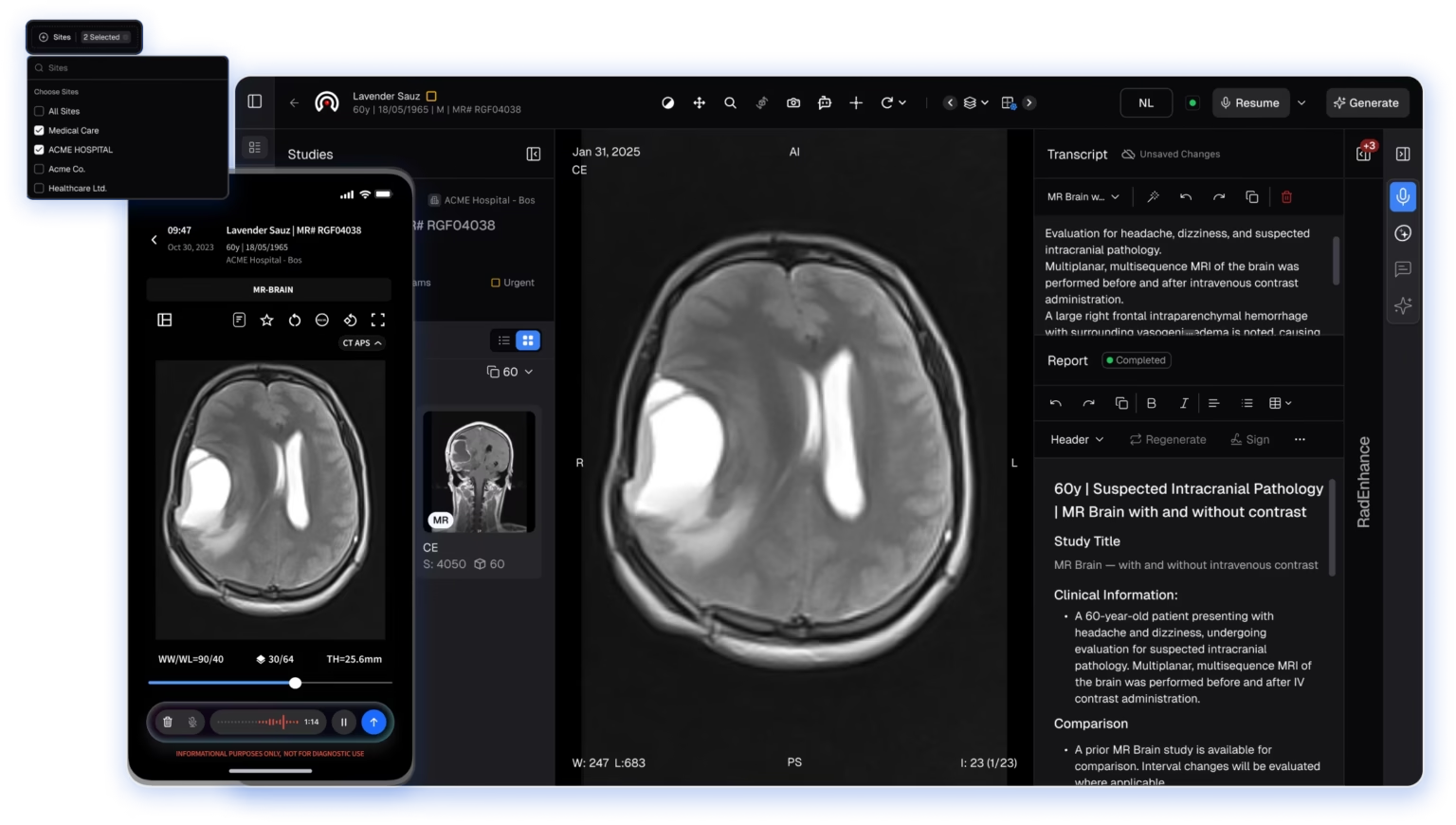
RadioView.AI's RadReport™ drafts structured, modality-appropriate reports that radiologists review, refine and sign rather than author from scratch. The cognitive shift from authoring to editing is significant: it preserves the clinical judgment that requires human expertise while eliminating the mechanical overhead that consumes radiologist time.
Teleradiology and Remote Reading
Remote reading arrangements allow practices to distribute worklist volume across geographies and time zones, extending coverage hours without requiring on-site presence. Combined with cloud-based DICOM platforms, teleradiology has become a viable primary coverage model for many community facilities.
Subspecialty AI Assistants
Narrow AI models trained on specific modalities and body regions (neuroradiology, musculoskeletal, chest) act as subspecialty assistants within the reading workflow. These tools flag findings that warrant subspecialty attention and route studies appropriately, reducing the rate of missed incidental findings under high-volume conditions.
Automated Reporting Engines
Structured report automation not only reduces time-per-study; it improves report consistency and downstream billing capture. RadioView.AI's RadEnhance surfaces real-time suggestions while the draft report and its dictation are being generated, so details are not lost under time pressure.
A Structural Problem Requiring a Structural Response
No single intervention eliminates a structural workforce deficit. The radiologist shortage will require parallel action: expanding training capacity over the long term, improving retention through reduced administrative burden, and deploying AI tools that multiply the output of every radiologist currently in practice.
The practices that are navigating this environment most effectively are not waiting for policy-level solutions. They are using AI to do more with the radiologists they have, while those radiologists focus their expertise where it matters most.
Learn more about how RadioViewAI supports radiology practices managing high-volume environments, or read our analysis of the four AI trends reshaping radiology in 2026.
Junaid Kalia, MDFounder and CEO, SaveLife.AIAll articles